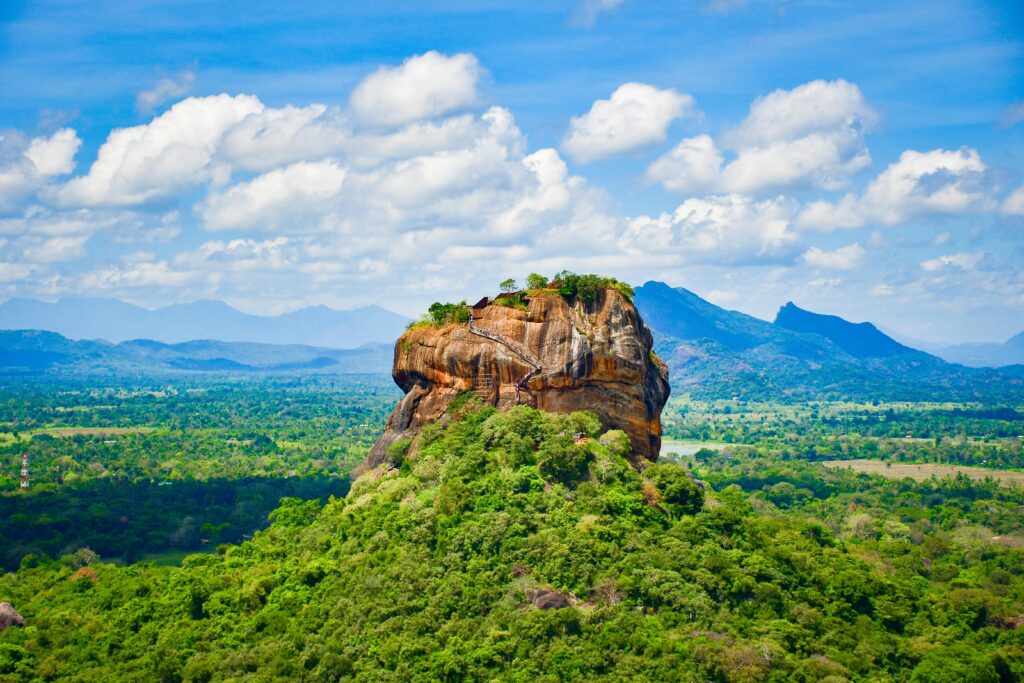
Rising abruptly from the emerald plains of Sri Lanka’s central province, Sigiriya Rock, or the Lion Rock, is a staggering UNESCO World Heritage site that blends ancient urban planning with natural wonder. This 200-meter-high granite peak served as the capital for the usurper King Kasyapa in the 5th century, who transformed the summit into an impregnable sky palace to protect himself from his rivals. Today, visitors begin their ascent through some of the world’s oldest landscaped water gardens and boulder-strewn paths, eventually reaching the famous Lion’s Gate. Though only two colossal stone paws remain, they serve as a powerful reminder of the massive lion’s head that once guarded the final staircase, where ancient travelers would literally walk into the mouth of the beast to reach the royal residence above.
As you climb the 1,200 steps to the summit, the journey reveals the artistic and engineering brilliance of the early Sinhalese civilization. Along the sheltered rock face, the vibrant Sigiriya Frescoes—depicting celestial maidens—remain remarkably preserved, followed by the Mirror Wall, which still bears centuries of poetic graffiti from ancient visitors. Reaching the 1.5-hectare summit rewards you with a panoramic view of the surrounding jungles and the ruins of the royal throne and bathing pools. Beyond its historical significance, Sigiriya is an architectural marvel where sophisticated hydraulic systems still feed working fountains 1,500 years later, making it an essential destination for anyone seeking to experience the “Eighth Wonder of the World.”